Life’s Lenses – through the eyes of Sheron Edwards, Mississippi political inmate
By CELESTE M. HART
Sheron Edwards wrote his autobiography, titled, Life’s Lenses, in one week from a prison cell, one of many in over 20 years. Edwards, currently serving an additional 20 years following an already 20 years shackled in Federal prisons for the same crimes, a carjacking with charges, armed robbery and grand larceny, no one killed, a total of 40 years. Some may consider this Double Jeopardy, the Constitution calls it, the Dual-Sovereignty Doctrine, Edwards calls it, Modern Day Slavery.
“The 13th amendment says that slavery was abolished except through imprisonment. Which means yes, I am a slave to the system. My trial was nothing but an auction. They sold me against my will,” said Edwards via phone.
In Life Lenses, Edwards, at 46-years old, describes his childhood more like an older man living in small town, Starkville, Mississippi, in the late 1800’s, not the early 1980’s. His graphic descriptions of the family dinners, childhood escapades, the conversations and church activities, delivers a feeling of a youngster listening, from the bottom step of a southern porch, looking up to an elder uncle or grandfather. It prompts visualizations like a scene from the movie, The Color Purple.
“Though we faced many of the hardships that most poor families in Mississippi faced during the seventies, I was only a child who simply knew life as we lived it…I was taught lessons, taught morals, taught to entertain listeners, taught humility, taught the Lord’s Prayer…a model to remind me that in spite of all extenuating circumstances, true happiness comes from within,” excerpt from Life’s Lenses.
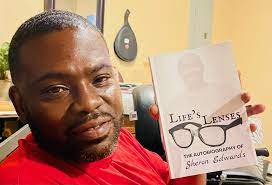
The three-part autobiography, Birth, Life and Death, and Awakened, contains 22 chapters each titled as a Lens that relates to his personal life, like, Foundational Lenses, Mid to Late 80’s Lenses (Family, Fights), Gangster Rap Lenses, Alcoholic Lenses, College to Prison Lenses and God’s Lenses.
Edwards details his time in Atlanta visiting LA Reid, his toxic relationships with women, the prisons’ inmate violence and codes, his depression, how childhood trauma leads to crime and his life’s turn around.
Edwards, at 23-years-old, in 1999, sentenced to 20 years in Federal prisons, learned in 2001, the State trial promised him, on release, to a consecutive sentence of an extra 20 years for the same crimes, just worded differently.
Edwards said, March 15, 1999, he watched the Mike Tyson vs Evander Holyfield fight with family and a friend, alibi witnesses not called to testify. Another friend picked him up in the stolen vehicle crashed into a pole and ran. Burns positively identified Edwards as the carjacker that hit him in the back of his head with a pistol, shot at him and missed.
“I never even shot at him, (victim Kenneth Burns), they fabricated that to obtain a conviction,” said Edwards.
“The dual sovereignty doctrine provides that when a defendant in a single act violates the ‘peace and dignity’ of two sovereigns by breaking the laws of each, he has committed two distinct offenses… it’s up to the discretion of the particular prosecutor,”
Starkville Police Captain David Lindley, the detective in Edwards’ case, wore his Ku Klux Klan robe to work, received a six-month probation, but returned in time to assist with Edward’s prosecutions. Burns, a white man, son of a Starkville municipal court judge, Edwards’ hands, never tested for gun residue, the pistol ‘found in the woods’ never tested for fingerprints, nor the wallet found in the police car’s back seat, and convicted by majority white juries with only the prosecutor’s corroborating witnesses, all white.
In a 1969 decision, the U.S. Supreme Court held that double jeopardy applies to both state and federal prosecutions under the Fourteenth Amendment doctrine of incorporation of rights.
Justice Samuel A. Alito, noted in an opinion, the Supreme Court has recognized the “dual-sovereignty” doctrine since 1847. All told, this evidence does not establish that those who ratified the Fifth Amendment took it to bar successive prosecutions under different sovereigns’ laws—much less do so with enough force to break a chain of precedent linking dozens of cases over 170 years.” there is no logical reason why incorporation should change it.”
Only seven cases, found via Wikipedia, in 1959, 1970, 1985, 2004, 2016, 2019 and the pending February 2022, appealed the Dual-sovereignty Doctrine, first six denied by the Supreme Court.
Justices Ruth Ginseng, deceased, and Neil Gorsuch, dissented in one case, suggested the court do a “fresh examination” of the “dual-sovereignty” doctrine.
The “dual sovereignty doctrine,” is an exception to the “Double Jeopardy Clause” of the U.S. Constitution. The Double Jeopardy Clause provides three types of protection: “[i]t protects against a second prosecution for the same offense after acquittal. It protects against a second prosecution for the same offense after conviction. And it protects against multiple punishments for the same offense.” Yale Law
“Under this concept of a federal system the citizen is required to obey two masters, concurrently, in a number of cases…Nothing is more repugnant or contradictory than two punishments for the same act…. It would bring our system of government into merited contempt,” James M. Feeley, Comment, Double Jeopardy and Dual Sovereignty, Wash. L. Rev. & St. B.J. 562 (1959).
“People ask me if I could go back in time, tell the younger version of myself something, what would it be? I would tell him to “never assume you know those around you, never trust the system to do the right thing, and know that racism exists on so many levels. Sheron, when they see your potential as a Black man in America’s society, you’re a threat. Proceed with caution!” said Edwards.
Listen to Sheron Edwards sing his original, Everything Else is a Plus
 theovergroundpost